Tag Archives: OpenId
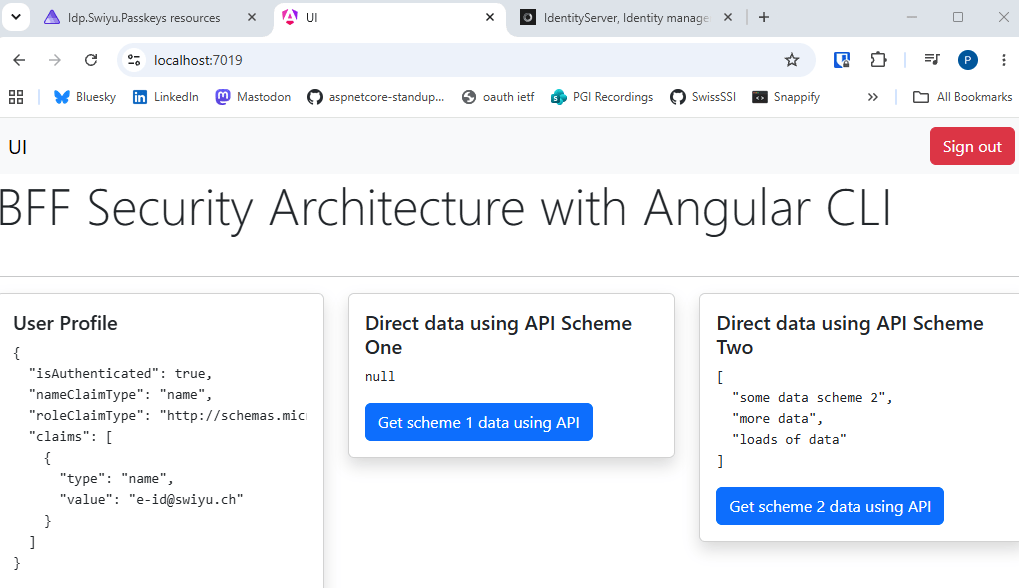
Use multiple schemes in an ASP.NET Core Web application
This article looks at using multiple authentication schemes in an ASP.NET Core web application. I required something like this when migrating a large application to a new identity provider and reducing the used OIDC servers down to one. Instead of migrating the multiple authentication schemes to a single cookie default scheme, it was quicker to […]
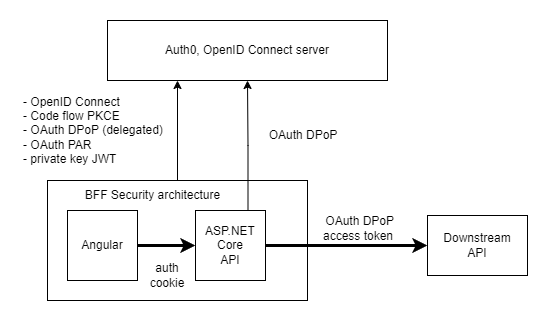
Implement BFF using Auth0, Angular and ASP.NET Core
This post should how to implement a web application which needs secure access and secure identities. The application uses Angular as the UI tech, ASP.NET Core as the backend tech and a backend for frontend security architecture using OpenID Connect, OAuth and Auth0 as the identity provider. Code: https://github.com/damienbod/Auth0BffDpopApi Blogs in this series Implement BFF […]
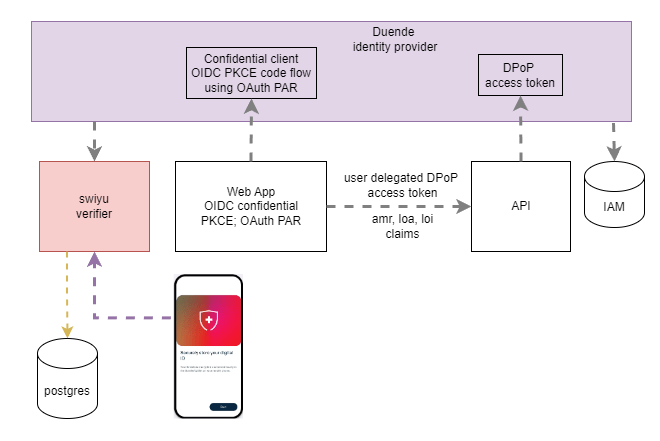
Implementing Level of Identification (LoI) with ASP.NET Core Identity and Duende
This article explores how to implement Level of Identification (LOI) in an ASP.NET Core application. The solution uses Duende IdentityServer as the OpenID Connect provider and ASP.NET Core Identity for user management. Identity verification is performed using the Swiyu Public Beta infrastructure. Any OpenID Connect client can consume the loi claim together with the loa […]

Digital Authentication and Identity validation
This post looks at authentication and identity validation and describes what should be validated and some of the concepts. With the increasing push to move processes to a digital world and the new threat models, authentication and identity validation MUST be implemented in a professional way. Using standards like OpenID Connect, OAuth and OpenID VCs […]

Use swiyu, the Swiss E-ID to authenticate users with Duende and .NET Aspire
This post shows how to authenticate users using Duende IdentityServer and ASP.NET Core Identity which verifies identities (verifiable digital credentials) using the Swiss Digital identity and trust infrastructure (swiyu). The swiyu infrastructure is implemented using the provided generic containers which implement the OpenID for Verifiable Presentations standards as well as many other standards for implementing […]

Using multiple APIs in Blazor with Microsoft Entra ID authentication
The post shows how to create a Blazor application which is hosted in an ASP.NET Core application and provides a public API which uses multiple downstream APIs. Both the Blazor client and the Blazor API are protected by Azure AD authentication. The Blazor UI Client is protected like any single page application. This is a […]

Securing an ASP.NET Core Razor Page App using OpenID Connect Code flow with PKCE
This article shows how to secure an ASP.NET Core Razor Page application using the Open ID Connect code flow with PKCE (Proof Key for Code Exchange). The secure token server is implemented using Duende IdentityServer but any secure token server (STS) can be used which supports PKCE. Code: https://github.com/damienbod/AspNetCoreHybridFlowWithApi See WebCodeFlowPkceClient project. History 2024-08-14 Updated […]
Building and securing an ASP.NET Core API with a hosted Vue.js UI
This article shows how Vue.js can be used together with ASP.NET Core 3 in a single project. The Vue.js application is built using the Vue.js CLI and built to the wwwroot of the ASP.NET Core application. The ASP.NET Core application is used to implement the APIs consumed by the Vue.js UI. The application is secured […]
OAuth using OIDC Authentication with PKCE for a .NET Core Console Native Application
This article shows how to use a .NET Core console application securely with an API using the RFC 7636 specification. The app logs into IdentityServer4 using the OIDC authorization code flow with a PKCE (Proof Key for Code Exchange). The app can then use the access token to consume data from a secure API. This […]
ASP.NET Core Authorization for Windows, Local accounts
This article shows how authorization could be implemented for an ASP.NET Core MVC application. The authorization logic is extracted into a separate project, which is required by some certification software requirements. This could also be deployed as a separate service. Code: https://github.com/damienbod/AspNetCoreWindowsAuth Blogs in this series: Supporting both Local and Windows Authentication in ASP.NET Core […]


