Tag Archives: OAuth
Force step up authentication in web applications
The post shows how to implement a step up authorization using the OAuth 2.0 Step Up Authentication Challenge Protocol RFC 9470. The application uses ASP.NET Core to implement the API, the web application and the identity provider. Duende IdentityServer is used to implement the OpenID Connect server standard and also OAuth DPoP token binding as […]
Implementing Level of Identification (LoI) with ASP.NET Core Identity and Duende
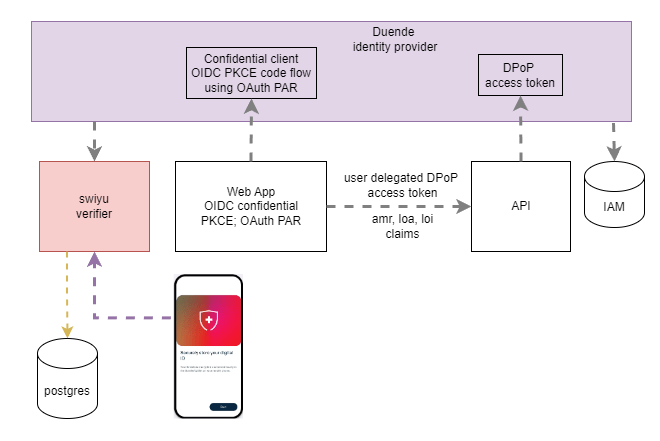
This article explores how to implement Level of Identification (LOI) in an ASP.NET Core application. The solution uses Duende IdentityServer as the OpenID Connect provider and ASP.NET Core Identity for user management. Identity verification is performed using the Swiyu Public Beta infrastructure. Any OpenID Connect client can consume the loi claim together with the loa […]
Implementing Level of Authentication (LoA) with ASP.NET Core Identity and Duende
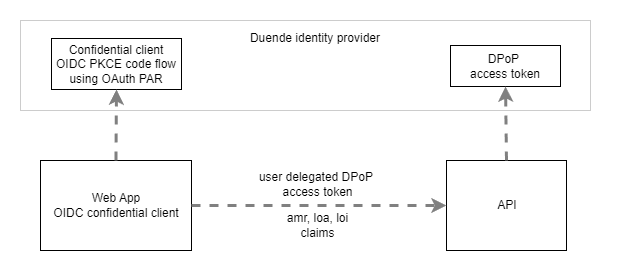
This post shows how to implement an application which requires a user to authenticate using passkeys. The identity provider returns three claims to prove the authentication level (loa), the identity level, (loi) and the amr claim showing the used authentication method. Code: https://github.com/swiss-ssi-group/swiyu-passkeys-idp-loi-loa Blogs in this series: The amr claim and the loa claim returns […]

Digital Authentication and Identity validation
This post looks at authentication and identity validation and describes what should be validated and some of the concepts. With the increasing push to move processes to a digital world and the new threat models, authentication and identity validation MUST be implemented in a professional way. Using standards like OpenID Connect, OAuth and OpenID VCs […]

Implement a secure MCP server using OAuth DPoP and Duende identity provider
This post demonstrates how an ASP.NET Core application can connect to a secure MCP server using OpenID Connect and OAuth. Both applications use Duende IdentityServer as the identity provider. The MCP server requires delegated DPoP access tokens. Code: https://github.com/damienbod/McpOidcOAuth Setup The UI application authenticates with the Duende IdentityServer using OpenID Connect. Upon successful authentication, a […]

Experimental alternative flow for OAuth First-Party Applications
This post looks at an alternative way of implementing a native app authentication and authorization. At present, a web browser is used to implement authentication of native applications when using OAuth and OpenID Connect. The alternative approach implemented in the post is based on the OAuth 2.0 for First-Party Applications draft and adapted to be […]

Implement client assertions with client credentials flow using OAuth DPoP
This blog looks at implementing client assertions for the client credentials flow using OAuth 2.0 Demonstration of Proof-of-Possession (DPoP). The client credentials flow is an OAuth 2.0 authorization grant type used for machine-to-machine authentication. DPoP further strengthens the security by ensuring that the client possesses a specific key at the time of the request, forcing […]

Implement client assertions for OAuth client credential flows in ASP.NET Core
This blog implements client assertions using an OAuth client credential flow in ASP.NET Core. Client assertions provide a secure way for client authentication without sharing a secret, enhancing the security the OAuth client credentials flow. By using JSON Web Tokens (JWTs) client assertions, this approach ensures strong client identity (application) verification and mitigates risks associated […]

ASP.NET Core user application access token management
This article looks at management application access tokens in an ASP.NET Core web application. Any application with or without a user can use application access tokens as long as the application can persist the tokens in a safe way. Code: https://github.com/damienbod/token-mgmt-ui-application Blogs in this series Setup The ASP.NET Core web application authenticates using OpenID Connect […]

Add a Swagger UI using a .NET 9 Json OpenAPI file
This post shows how to implement a Swagger UI using a .NET 9 produced OpenAPI file. The Swagger UI is deployed to a secure or development environment and is not deployed to a public production target. Sometimes, it is required to deploy the Swagger UI to a development deployment target and not the test or […]

 Software Engineering